Why Repeating a Plant Shape Gives a Border Rhythm
Repeating a plant shape gives a border rhythm without adding more varieties. Learn how to choose a form, place it and judge whether the pattern feels settled.
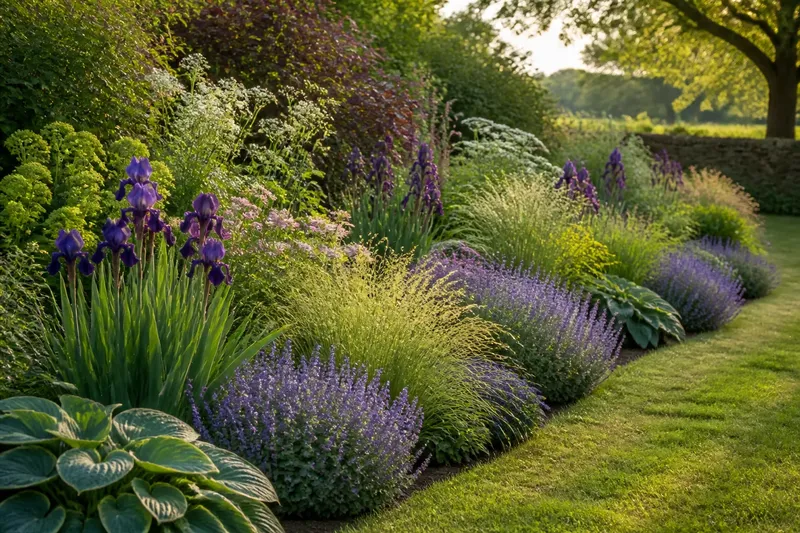
The common mistake in a crowded border is to add another variety when the planting feels unsettled. More names on the label may bring more colour, but they do not necessarily help the eye find its way; repeating a plant shape can give the existing mix a clearer rhythm instead.
That rhythm comes from returning forms: upright spikes, rounded mounds, airy sprays or broad leaves appearing at intervals. The plants need not match in colour or species. Their shapes simply give the eye something familiar to recognise as it moves along the border.
What does plant-shape repetition do?
In a border, rhythm is the sense that forms recur with enough regularity to connect separate parts of the planting. A repeated shape can link plants that flower at different times or belong to different colour groups. It acts rather like a refrain: recognisable, but not so constant that the whole composition becomes a chorus of one note.
Shape is easiest to read from a little distance. A column of iris foliage, a dome of hardy geranium or the fine spray of a grass can register before individual leaves and flowers do. Repeating one of these forms gives the border a visual pulse, while changes in height, texture and colour keep that pulse from becoming mechanical.
This is not the same as planting a row of identical specimens at equal intervals. That approach can suit a formal scheme, but mixed borders often benefit from repetitions that are related rather than rigid. A shape may return in a different plant, in a looser group or at a slightly altered height.
Which shape should return?
Begin with forms already present in the border, rather than choosing a plant because its catalogue photograph looks persuasive. Stand where you usually view the planting and look for a shape that appears more than once, or one that could connect two areas that currently seem unrelated.
- Upright forms, such as foxglove spires or iris leaves, draw the eye upwards and can punctuate a low, broad planting.
- Mounded forms, such as catmint or compact hardy geraniums, make low, rounded pauses between taller plants.
- Fine, airy forms, such as ornamental grasses or fennel, soften heavier foliage and allow glimpses through the border.
- Broad, architectural leaves, such as those of a hosta or bergenia, create substantial blocks that can anchor finer textures.
These are visual descriptions, not planting prescriptions. A form that works in one border may be too dominant in another, and the mature spread, light preference and soil needs still matter. Check the plant label and manufacturer or supplier guidance where relevant, then choose a candidate that suits the site as well as the composition.
Pay attention to the shape’s seasonal presence, too. Some plants hold a clear outline after flowering; others disappear or become indistinct. If the chosen form vanishes for part of the year, another plant with a similar outline can carry the repetition in its place.
Should you repeat one plant or related forms?
There are three useful approaches, each suited to a different border and gardener.
When does repeating the same plant suit a border?
Use the same plant when you want the shape to read clearly and the site offers consistent growing conditions. Repeating a compact mound or a group of upright perennials can create a strong, legible pattern, especially where the rest of the planting varies. It suits a border that feels scattered and needs a firm visual anchor.
The limitation is equally clear: the plant’s foliage, flower colour and seasonal timing will recur as well as its outline. If the species is vigorous or visually dominant, several placements may make it feel less like a rhythm and more like a recurring interruption. Keep the repeated plant in proportion to the rest of the border.
Can different plants share the same shape?
Yes. A border can repeat rounded forms through different plants, or return to vertical accents using several kinds of spire. This suits a mixed planting where you want continuity without making every repeated point identical in colour or texture.
Choose forms that are recognisably related from the viewing distance, not merely similar in close-up detail. A low globe and a tall, narrow column are both simple shapes, but they do not create the same visual beat. Look at the whole silhouette before treating them as part of one pattern.
What if the border already has plenty of repetition?
Then leave it alone for a while. Repetition can already be present in neighbouring foliage, repeated flower heads or a sequence of similar plant heights, even if no one deliberately planned it. This approach suits borders with plenty of established plants, where adding another repeated form may make the pattern too emphatic.
It is not worth the effort to map every leaf or hunt for a perfect geometric interval. A quick look from the path or window is often enough to reveal whether a shape returns, disappears or gathers too heavily in one place.
Where should the repeated forms go?
Placement determines whether repetition feels like a connection or a row. If each matching shape sits at the same distance from its neighbour, the border can look lined up, even when the plants differ. Slightly varied spacing usually feels more natural, provided the returning form remains easy to recognise.
Think in groups and gaps rather than a ruler’s sequence. A mound might appear near the front of one section, then return further back where the border widens. Upright forms can mark transitions between a dense planting and an open patch. The eye follows the recurrence, while the changes in position keep the border from looking like a queue.
Imagine a border with a large patch of blue flowers at one end and a group of pale flowers at the other, with little to connect them. You could use an existing rounded plant shape in a smaller group between those patches, placing it where a path-side view can pick it up. The expected result is a visible link across the border; if the middle group disappears behind taller foliage, move the emphasis to a clearer gap rather than adding several more plants.
Keep the surrounding forms in mind. A repeated upright can become more apparent against a low mound, while the same upright may disappear among other tall stems. Contrast helps the recurring outline register; too much contrast, repeated at every turn, can make the border restless.
How can you judge whether the rhythm works?
Look from the places that matter: the garden entrance, a seat, a kitchen window or the path beside the border. A pattern that reads while standing close may vanish from a window, and one that looks orderly head-on may feel repetitive when viewed along the bed.
Try these checks before buying more plants:
- Can you identify the returning shape without naming the plant?
- Does it appear in more than one part of the border, rather than collecting in a single cluster?
- Is each recurrence visible, or hidden by a taller neighbour?
- Do neighbouring shapes provide enough contrast for the repeated form to stand out?
- Does the pattern still make sense when flowers are absent?
- Would removing one recurrence leave a gap, or make the border calmer?
These questions are more useful than counting specimens. A border does not need evenly spaced repetitions to feel connected. It needs enough recognisable returns for the eye to notice a relationship, with enough variation to keep the planting alive.
How do you choose between the three approaches?
Choose the same plant when the border needs a strong, consistent anchor and the site suits that plant throughout. Choose related shapes when you want a recognisable pattern with more variation in colour, foliage or flowering time. Choose not to add anything when the forms already recur or the planting’s other contrasts are doing useful work.
Before changing the border, make a simple shape map from your usual viewpoint. Mark only the main mounds, spikes, sprays and broad-leaved forms; there is no need to catalogue every plant. If the map shows one shape confined to a corner, you might echo it elsewhere. If several shapes already return across the bed, the better decision may be to let them settle.
Why repeating a plant shape gives a border rhythm is ultimately a question of recognition, not arithmetic. Notice what the eye already follows, then decide whether one clear recurrence would help. A border can gain coherence without gaining another plant, which is a comparatively rare invitation to put the trowel down.