The Myth of the One-Weekend Garden Makeover
A one-weekend garden makeover can create more work than clarity. Change one feature at a time, observe what follows and make better decisions for the whole garden.
The usual one-weekend garden makeover begins with a crowded border, a trip to the garden centre and a wheelbarrow full of plants whose positions have not been settled. A one-weekend garden makeover can leave you with more watering, more uncertainty and less room to see what the garden actually needs. The quieter alternative is to make one deliberate change, then live with the evidence before choosing the next.
What is the weekend supposed to fix?
Imagine a clearly hypothetical situation: Mara has a small back garden with a narrow lawn, a damp patch beside the shed and a border that looks sparse in early spring. She decides the whole space needs a dramatic overhaul, though she cannot say whether the main problem is the empty border, the lawn or the awkward shed corner. That uncertainty is the first useful clue: a large project is being asked to solve several different questions at once.
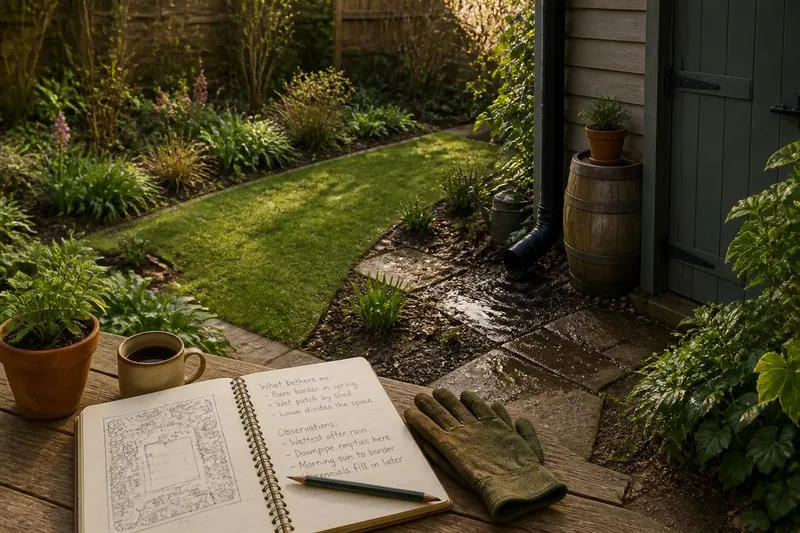
Instead of buying plants and materials immediately, Mara writes down what bothers her and where it occurs. The border looks bare before its perennials emerge; the shed corner stays wet after rain; and the lawn makes the garden feel divided. Those are three observations, not one design problem, and each may call for a different response.
She spends a little time looking at the garden at different points in the day and after ordinary weather. A simple notebook is enough: note where water lingers, which areas receive sun, and what is already present before deciding what should change. This is not a demand for a formal survey. It is a way to avoid treating a symptom in one corner as a verdict on the whole garden.
Why change only one thing first?
Mara chooses the damp shed corner as her first project because it is a specific, recurring inconvenience. She does not also remove the lawn, rework the border and replace the path. If she changed all of them together, she would have little chance of telling which decision helped, which created a new problem, or which simply looked appealing on planting day.
Her first action is modest: she clears fallen leaves and loose debris from the corner, then watches how water behaves after rain. She checks whether the wetness is confined to the surface or whether the ground remains soggy, and whether water appears to be arriving from a roof edge or another nearby source. The point is observation, not a rushed drainage scheme.
Say Mara notices that the patch stays wet where a downpipe empties, while the rest of the corner dries more readily. She redirects her attention to the source of the runoff rather than buying moisture-loving plants for the whole area. The expected observable result is that the patch changes after rain; if it does not, she has learned that the downpipe was not the only factor and can reassess before adding another intervention.
Any change involving a downpipe, drainage, or a structure should follow the relevant product instructions and local requirements; where the work is beyond routine garden care, she should consult a qualified professional. That boundary keeps a small garden decision from turning into an improvised building project.
What does the pause reveal?
After attending to the runoff, Mara gives the corner time to show its pattern through ordinary weather. She keeps the cleared area visible rather than immediately filling it with pots. This pause is useful because a bare patch makes changes easier to notice: persistent puddling, fresh leaf litter, or the way the soil surface dries.
She also leaves the spring border alone for now. Its early-season emptiness had seemed like a demand for new plants, but she observes that existing perennials later occupy much of the space. The garden has not become fuller because she intervened; she has simply seen more of its seasonal character before committing to extra planting.
The lawn remains as it is. It still divides the space, but the shed corner no longer dominates Mara’s attention, and the border looks different as its plants develop. This does not prove that the original garden was fine. It gives her a more accurate starting point for the next decision.
How should she choose the next change?
Once the wet corner is no longer the immediate question, Mara turns to the border. She marks the areas that remain bare after the existing plants have grown, rather than filling every gap visible at the start of spring. A few temporary markers or a quick sketch help her remember where she saw empty ground and where plants later spread.
Her next change is to add a small group of suitable plants to one persistently open section, chosen for the site’s observed light and soil conditions. She checks the plant labels for the conditions and care needs that matter, and leaves adjacent sections untouched. That gives her a clearer view of how the additions sit with the established planting and whether the gap was genuinely persistent.
She does not try to make the new plants look mature on arrival by buying large specimens for every bare patch. Small additions can be easier to place and adjust, while a restrained purchase keeps the unaltered parts of the border available for comparison. The decision is not that small plants are always better; it is that the scale of the change should match the confidence of the diagnosis.
What questions tend to come up?
How long should I wait before making another change?
Wait long enough to observe the result under the conditions relevant to the decision: after rain for a damp patch, or through the growing period for a planting gap. There is no useful universal timetable; make the next change when you can describe what happened rather than merely feeling impatient with the unfinished appearance.
Can a one-weekend garden makeover ever make sense?
It can suit a clearly bounded task, such as clearing a defined area or planting a prepared bed, when the decisions and conditions are already understood. It is less helpful as a promise to solve every unrelated concern in the garden at once.
What if the garden still looks unfinished?
Separate temporary incompleteness from a genuine problem. A patch may need time to establish or reveal its seasonal pattern, while a persistent obstruction or unwanted runoff deserves a more direct response.
Is it worth buying a complete set of matching materials?
Not before you know which parts of the garden need them and how they will meet existing edges, paths or beds. A sample, a drawn boundary or a small trial area can expose an awkward fit before a larger commitment.
What is not worth the effort?
Mara does not spend the season chasing a perfectly finished view from every angle. Nor does she keep moving healthy plants because a new arrangement looks more exciting in a catalogue. These efforts create activity without answering the central question of whether the garden has improved in use, appearance or maintenance.
She avoids buying a full suite of new pots, edging and decorative objects to make a modest planting change look like a complete transformation. Those details can be chosen later if the garden still needs them. For now, the most useful tool is the notebook, which costs less than a collection of objects bought to disguise uncertainty.
What does the garden look like after one season?
By the end of the growing season, Mara has made two main changes: she has addressed the likely source of runoff and added plants to a border gap that remained open. She has not removed the lawn or rebuilt the whole garden. The shed corner is easier to assess after rain, and the new planting can be judged alongside the established border rather than as part of a wholesale reset.
Some questions remain. The lawn still separates the space, and the border may need another adjustment when its plants return. Those unresolved points are not evidence that the work failed; they are decisions Mara can now make with a better understanding of the garden’s behaviour.
The practical lesson of the one-weekend garden makeover is not to avoid substantial work. It is to reserve that effort for a problem you can describe, and to avoid disguising several unanswered questions as one grand project. Change one feature, observe what follows, and let the next decision respond to what the garden actually does.
When choosing a one-weekend garden makeover, treat the weekend as a convenient moment to begin, not a deadline for finishing everything. A clear note about what changed and what you saw afterwards will make the next visit more useful than another hurried trolley of hopeful purchases.